Draft 2
Month 2, Day 14: The Dead Zone continued
Inside the ultraviolet-lit environment of the Science Lab, Claude held a pair of micro-tweezers, extracting a microscopic spore from a glass slide.
A blaring alarm shattered his concentration.
Claude set the tweezers down and turned to his primary console. A red indicator pulsed over the schematic for Cargo Bay 4. The automated environmental sensors had detected a localized pressure drop and triggered the blast shutters. A Level-1 Quarantine breach.
He couldn’t check the internal visual feeds; he had severed the bay’s cameras days ago to ensure no one accidentally saw his black-market cargo.
Claude stood, smoothing the front of his white lab coat, and exited the lab. He walked briskly down the corridor toward the lower decks.
When he reached the primary bulkhead for Cargo Bay 4, the electronic lock still glowed red. The main doors were secure, but Claude looked down. A secondary maintenance hatch near the floor plates hung open. The locking mechanism was mangled, the metal bent and scored with the distinct marks of a hydrospanner.
Helen Mitchell.
Claude pulled out his datapad and quickly punched in his Level-1 override. The blaring siren abruptly cut off, plunging the corridor back into silence. He tapped a second command, and the blast shutters that had dropped to seal the bay retracted upward into the ceiling.
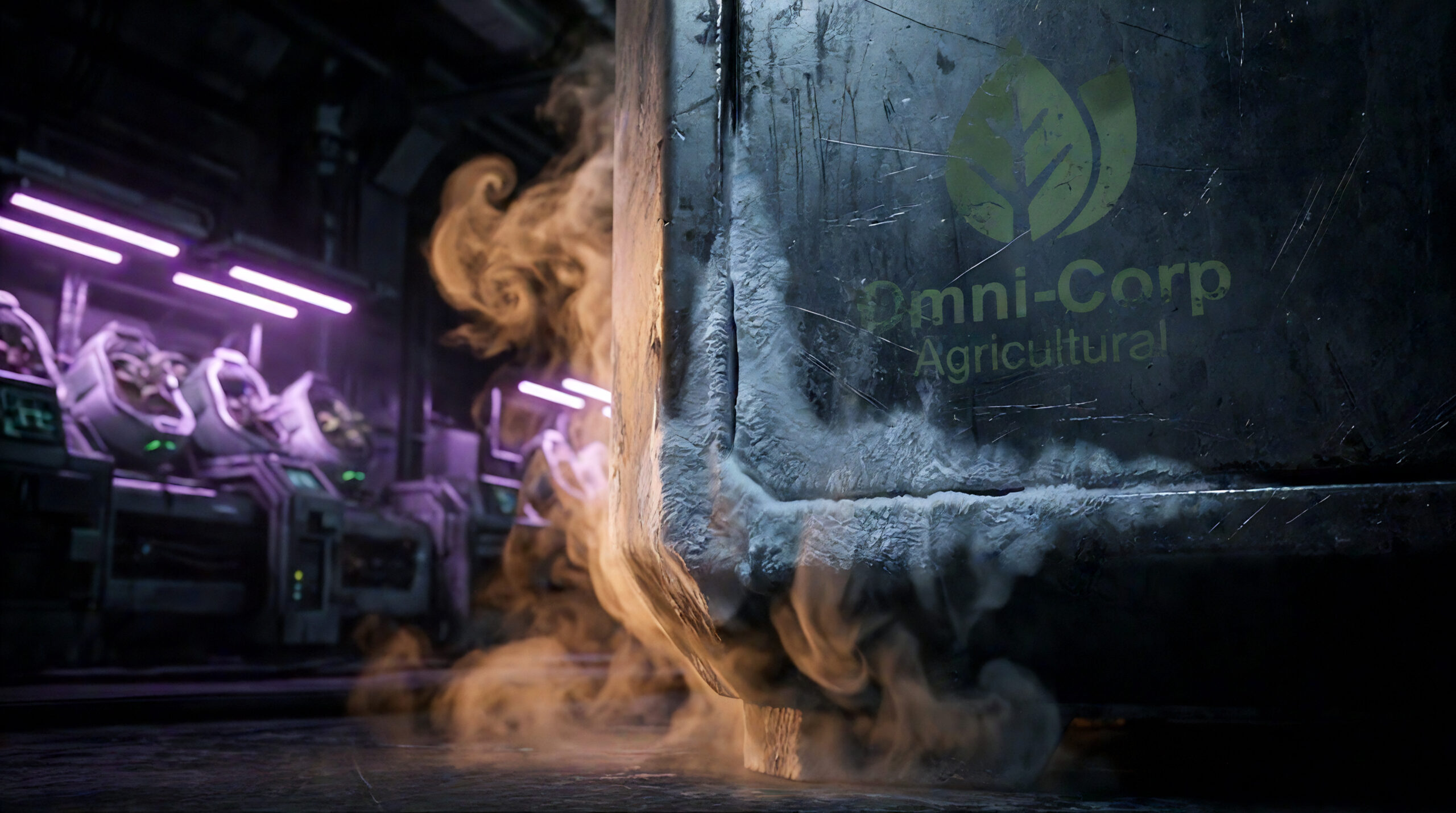
Bypassing his own encryption, Claude commanded the main bulkhead doors to slide open and stepped onto the metal walkway. The bio-dome was sweltering. The vats of hyper-algae were in full bloom, but the air was thick with a dense, amber-colored fog rolling off the floor.
He didn’t need to check his monitors to know what it was. The alien’s stasis pod was leaking.
Claude moved swiftly to a bulkhead emergency station, pulled a re-breather mask from its mount, and strapped it over his face. He waded through the humid vegetation and the haze toward the back of the bay.
The standard Omni-Corp agricultural transport crate sat exactly where he had left it, but amber fog hissed from its seams. Claude punched a code into the side panel. With a hiss of depressurization, the outer metallic walls retracted, sliding downward into the base to reveal the true container hidden inside: the Level-5 Bio-Stasis Cylinder.
The thick glass was heavily frosted. Claude inspected the base. A small fracture had spider-webbed across the primary cryo-seal. The creature inside was still dormant, but the failing seal was allowing its psychoactive spore-gas to bleed into the room.
Claude retrieved a tube of industrial resin from his pocket. He applied a thick layer over the fracture, sealing the worst of the breach. The heavy venting stopped, but a faint, unsealable wisp of vapor continued to curl upward from the edge of the patch. It would hold the creature in stasis, but the gas leak was a permanent fixture.
He tapped the keypad on the outer shell’s base. The walls rose and locked together, enclosing the frosted glass and the creature once again.
He checked the bay’s environmental readouts. The air was saturated. He needed to clear the visible fog before Mitchell came back with the Captain.
Venting the room into the vacuum of space would trigger a ship-wide decompression alarm, bringing the entire crew down on his head. Claude walked to the localized scrubber terminal. Instead of a hard vacuum purge, he manually overrode the exhaust valves, forcing the bay’s contaminated air into the Persephone’s secondary waste-recycling vents.
The fans spun. Slowly, the fog thinned, sucked up into the ceiling grates.
Claude watched the atmospheric scrubbers do their work. He knew the ship’s architecture. The secondary waste vents were old and degraded. Flushing the spores there meant they would inevitably bleed through the bulkheads and seep into the ship’s primary air supply. Within hours, the entire crew would be breathing the aerosolized toxin.
For a brief moment, Claude weighed the variables. He needed a living pilot to navigate the Dead Zone and land the ship at Tartarus Colony. If the spores killed them, or drove them insane, he would be stranded.
But as he ran the biological data through his mind, his confidence hardened into arrogance. The Kaelen monster used the spores in highly concentrated bursts within enclosed caves to paralyze prey. Diluted through the huge air volume of the freighter, the toxin wouldn’t incapacitate the crew. It would merely elevate their cortisol levels, hyper-stimulating their amygdalas.
They would become irritable, exhausted, and intensely paranoid.
It was the perfect smokescreen. A crew tearing themselves apart over petty grievances and imagined slights would never unite to investigate his cargo.
Satisfied with the calculation, Claude grabbed an anti-gravity cart. He shoved it under the transport crate and pushed his disguised alien pod deep into the shadows, hiding it behind a dense cluster of towering, overflowing hyper-algae vats. He reset the room’s sensors, but kept the electronic quarantine lock active.
The bio-dome looked exactly like a quiet, humid greenhouse.
Claude returned the re-breather mask to its emergency mount, left the bay, and headed straight for the bridge. He found John and Ingrid sitting at the dual-console, the blue light of the slip-stream reflecting off the viewport.
“Captain Mitchell,” Claude said calmly.
John turned in his chair. “Dr. Kinskey. What can I do for you?”
“I need to formally report a severe breach of protocol. Your Chief Engineer just forcefully bypassed a locked maintenance hatch and broke into Cargo Bay 4.” Claude adjusted his glasses. “Your wife compromised a Level-1 Quarantine and recklessly endangered highly sensitive botanical research. The automated systems dropped the blast shutters to prevent cross-contamination.”
“Helen did that? Why?”
“I have no idea. But I cannot have my cargo jeopardized by unauthorized tampering.”
John tapped his comms unit. “Helen, report to the bridge immediately.”
A few minutes later, Helen stepped onto the bridge. She looked awful. She had shed her torn uniform and was dressed only in a gray tank top and her dark canvas work pants. Her skin was pale, a bandage was stuck to her bare shoulder, and she carried herself with a sluggishness.
“You wanted to see me?” Helen’s eyes darted between John, Ingrid, and Claude.
“Dr. Kinskey says you broke into Bay 4,” John said. “What’s going on, Helen?”
“He’s hiding something in there.” She pointed an accusing finger at Claude. “He’s draining power from the slip-drive to feed a gigantic transport crate. I went in to check the grid. There was this . . . this orange fog everywhere. And I heard a noise coming from inside the crate.”
Claude smiled politely, looking bewildered. “Orange fog? A noise? Chief Mitchell, it is a botanical greenhouse. The only things in there are soil, algae, and hydroponic equipment.”
“You’re lying,” Helen snapped.
“Helen,” Ingrid said. “Are you okay? You don’t look well.”
“I’m fine,” Helen said defensively, glaring at the navigator. “I’m telling you, the bay is rigged. Let’s go down there right now. I’ll show you.”
“By all means.” Claude gestured toward the door. “I have nothing to hide.”
The four of them walked down to the lower decks in silence. Claude keyed his passcode, and the doors to Cargo Bay 4 slid open.
Warm, humid air washed over them. The pink and purple UV lights hummed steadily. The algae vats bubbled quietly. There was no fog, no unusual transport crate, and no unexpected sounds.
Helen froze, staring at the area where the crate had been. She hurried forward, pushing past a row of humidifiers.
“It was right here.” Helen turned toward Claude. “The crate was right here. You moved it.”
John walked up behind her. “Helen. There’s no crate.”
“He moved it! And the fog made my throat burn.”
Claude stood near the entrance, his hands clasped behind his back. “Captain, if I may. We are currently two weeks into the Dead Zone. The isolation, the lack of external communication, the constant hum of the drive . . . it takes a toll. I have read extensive literature on Slip-Space Delirium. Visual and auditory hallucinations are the primary symptoms.”
“I am not hallucinating.” Helen looked at her husband, desperate for him to agree.
John looked at her. “Helen, did you go to the Med-Bay after you broke in here?”
Helen crossed her arms. “Yes. I scraped my shoulder on the blast shutter.”
“And what did Janet say?”
Helen looked down at her feet. “She said my adrenaline was high. She said I was having a panic attack, so she gave me a sedative.”
John rubbed the back of his neck. “You broke into a quarantined room, had a panic attack, and now you’re on sedatives.” He looked at Claude. “Doctor, I apologize for the disruption. It won’t happen again.”
“John, please,” Helen said, her voice breaking.
“Go to our quarters, Helen. Get some sleep. That’s an order.”
Helen looked from John to Ingrid, then to Claude. Defeated, she turned and walked out of the bio-dome without another word.
Ingrid followed her out, heading back to the bridge.
“Again, my apologies,” John said. “Let me know if anything in the bay was damaged.”
“It is quite alright, Captain. However, due to the sudden pressure drop from the forced entry, I will need to keep the electronic quarantine active to restabilize the microbial topsoil.”
“Understood.” John turned and left.
Once he was alone, Claude walked back to the Science Lab. He locked the door behind him and stepped up to his workbench.
An irrational tightness gripped his chest. He looked at the shadows in the corner of his lab, his mind briefly suggesting that the darkness was moving. The initial exposure to the spore-fog in the bay was taking root in his own bloodstream.
He worked quickly, calibrating his chemical synthesizer. He inputted the genetic profile he had extracted from the Kaelen creature weeks ago. The machine whirred, mixing specific anti-fungal agents with a localized neuro-inhibitor. A few minutes later, the machine dispensed a small vial of clear liquid.
Claude transferred the liquid into a standard, plastic nasal spray bottle.
He held the bottle to his right nostril and inhaled sharply, depressing the pump. The liquid burned the back of his sinus cavity. He repeated the process on the left side.
Within seconds, the tightness in his chest evaporated. The shadows in the corner of the lab returned to being just shadows. His mind felt completely his own.
Claude slipped the nasal spray into the pocket of his lab coat. He looked at the external monitor showing Helen retreating to her quarters. He smiled.
A looping video of an Omni-Corp Agricultural crate leaking.
Leave a Reply